Angkor in Two Days: The Order That Actually Works
Updated September 25, 2026 · 7 min read

Almost every two-day itinerary you will be offered runs the same way: sunrise at Angkor Wat, then Angkor Thom and Bayon, then Ta Prohm, then the outer temples on day two. It is not wrong. It is just the same plan everybody else has, which means you meet the same people at the same hour in the same doorway.
Two facts change the order, and neither is on the map.
Angkor Wat faces west – and that is unusual
Nearly every Khmer temple faces east. Angkor Wat faces west, which is why its sunrise photograph is a silhouette: at dawn the sun comes up behind the towers and you are looking at the dark side of the building. That is a wonderful picture, and it is the only picture you will get at that hour.
In the late afternoon the sun swings round and lights the façade directly – the full length of the western causeway, the galleries, the carvings. The temple looks completely different, and there are far fewer people in it, because the crowd that queued at 05:00 went back to the hotel at eleven and the sunset crowd has gone to a hill.
So do not treat Angkor Wat as a single visit. Treat it as two: the silhouette at dawn and the building itself at four in the afternoon.
The heat decides the middle of the day, not you
From November to February it is around 25 to 30 °C and pleasant. In April it regularly sits at 35 to 38 °C and can touch 40 °C, and the rainy season from May to October brings heavy afternoon downpours, with September and October the wettest months of all.
Any plan that has you walking a temple complex between eleven and three in April is a plan written by somebody who was not there in April. The two-day routes below keep that window loose deliberately.
Day one: the inner circuit, in the order nobody uses
05:00 – Angkor Wat, sunrise. Be at the northern reflecting pond, front-left corner. Expect thousands of people in peak season, and take a torch for the 350 m causeway.
06:30 – leave Angkor Wat. This is the move. The crowd walks into Angkor Wat after sunrise and then drifts north to Angkor Thom. If you go straight to Ta Prohm instead, you get the tree-and-ruin temple before the coaches, at a time of day when the light comes through the canopy sideways rather than straight down.
08:30 – Angkor Thom and Bayon. The faces on the Bayon towers need side light, which means morning or late afternoon; at noon they flatten out completely. Add the Terrace of the Elephants and Baphuon while you are inside the walls.
11:00 – stop. Go back into town, eat, sleep, swim. This is not a wasted hour, it is what makes the afternoon possible.
16:00 – Angkor Wat again, the west façade. Now the building is lit and you can actually look at it. This is also the right time for the Bakan, the upper tier – it opens around 07:40 and closes around 17:00, children under twelve are not allowed up, and it is closed on Buddhist holy days, about four days a month. A sleeved top is genuinely required there; a scarf over bare shoulders will get you turned away at the stairs.
17:30 – sunset. Phnom Bakheng is open until 19:00 and has the famous view and the famous queue. Pre Rup is open until 19:00 too, faces the right way, and is quieter.
Day two: the outer circuit and Banteay Srei
Day two has no fixed answer, because it depends on what day one made you want more of.
If you want more carving: head out to Banteay Srei, about 32 km from town – small, pink sandstone, and the most finely carved thing in the region by a wide margin. It is covered by your Angkor pass. Pair it with Kbal Spean, the riverbed carvings known as the River of a Thousand Lingas, which is also on the pass.
If you want more scale and fewer people: do the grand circuit – Preah Khan, Neak Pean, East Mebon, Pre Rup. These take about as long as the inner circuit and carry a fraction of the visitors.
If you want jungle: Beng Mealea, around 60 km out and largely uncleared, is what Ta Prohm was before the walkways. Also on the pass.
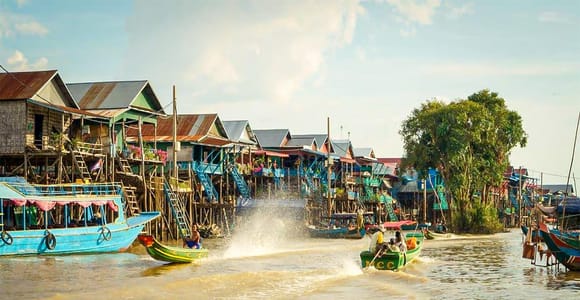
If two days of temples is enough: take the second day off the temples entirely and go to the floating villages on the Tonlé Sap or into the countryside. Temple fatigue is real and arrives faster than people expect, and there is no prize for pushing through it.
What to book, and what it costs
Among the guided temple tours the most-reviewed two-day version carries 5,038 reviews at 29.88 € and covers sunrise on day one and sunset on day two. That price is the guiding and the transport. The Angkor pass is separate: 62 US$ for the three-day pass, which is the one that fits a two-day plan, and it is cheaper than buying two single days at 37 US$ each. The full arithmetic is in our pass guide.
Doing it by tuk-tuk instead works perfectly for the routing above, with one caveat worth repeating: a driver is not a guide, and on a two-day plan that gap gets wider, not narrower. By the fourth temple, “which king built this one” stops being a small question.
Two mistakes that cost a whole morning
Booking sunrise on both days. The second one is never as good, you are tired, and you have given up the afternoon light on Angkor Wat to get it. One sunrise, one sunset.
Saving the Bakan for “later”. Between the 07:40 opening, the 17:00 closing, and about four holy-day closures a month, the upper level is the one part of Angkor that can simply be unavailable on the day you finally get round to it. If it matters to you, go up on day one and ask at the gate that morning whether it is open at all.
The rest of Angkor will still be there on day two. That tier might not be.