The Angkor Pass: 1, 3 or 7 Days – Which One Fits Your Trip
Updated September 25, 2026 · 6 min read
There are exactly three Angkor passes, one official seller, and a handful of rules that decide whether you overpay or not. None of it is complicated, but almost all of it is easy to get wrong on the day you arrive.
The three passes and what they cost
| Pass | Price | Usable on |
|---|---|---|
| 1 day | 37 US$ | the printed date only |
| 3 days | 62 US$ | any three days inside a one-week window |
| 7 days | 72 US$ | any seven days inside a one-month window |
The days do not have to be consecutive. You can use a three-day pass on Monday, skip Tuesday to sleep and swim, and use it again on Wednesday and Friday.
Two US$ from every pass goes to the Kantha Bopha children’s hospitals, which treat Cambodian children free of charge. That is not marketing – it is printed on the ticket structure itself.
The arithmetic almost nobody does
Look at the gaps rather than the prices:
- Two separate one-day passes cost 74 US$. The three-day pass costs 62 US$. If there is any chance at all that you will want a second day, the three-day pass is already the cheaper purchase – and it throws in a third day.
- The seven-day pass costs 10 US$ more than the three-day pass. Four extra days for ten dollars.
So the real decision is not “how many days do I want” but “am I certain I want only one”. For most people the answer is no, and the three-day pass is the sensible default.
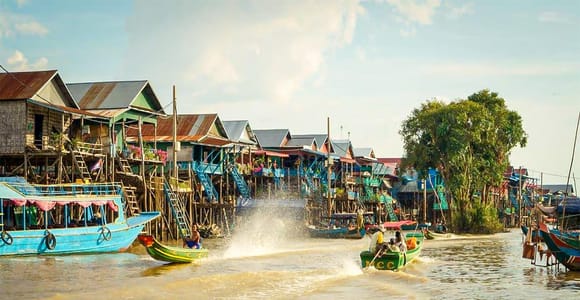
Buy one day only if you are here on a stopover with a single free morning, or you already know that temples are not your thing and you are coming mainly for the floating villages and the countryside.
Buy seven days if you are staying a week or more, or if you plan to go slowly – early mornings, back to the pool at eleven, out again at four. In April, when temperatures regularly sit at 35 to 38 °C and can touch 40 °C, that rhythm is not laziness, it is the only way to enjoy the place.
Where to buy it – and where not to
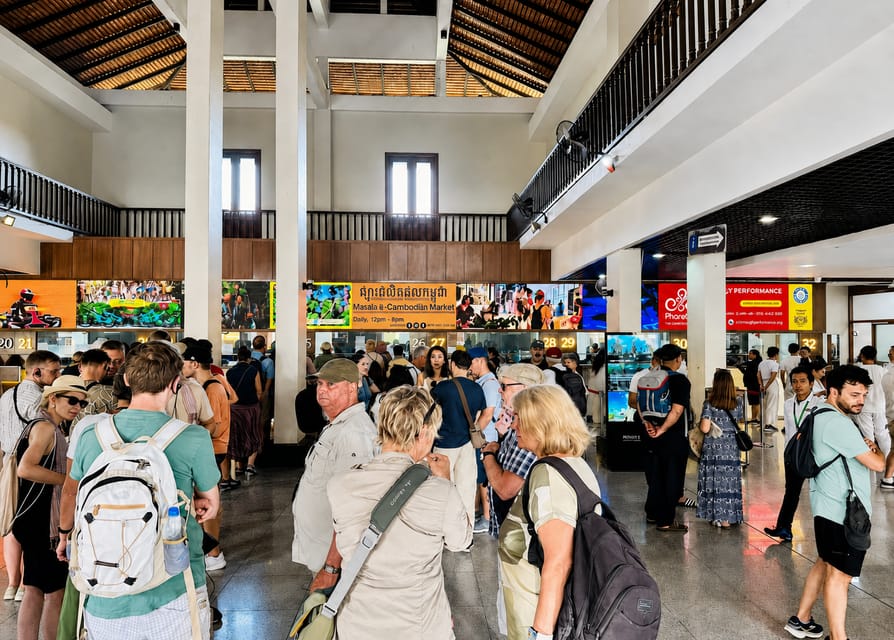
The only official seller is Angkor Enterprise: online at their ticket site, or in person at the Angkor Ticket Office on Road 60, open 04:30 to 17:30 every day. There is no ticket counter at Angkor Wat itself. Turning up at the temple without a pass means driving back.
A photo is taken for the three- and seven-day passes and printed on them. The one-day pass does not need one. The pass is personal and non-transferable, and it is checked at the entrance to every major temple – not once at the gate.
Resellers exist too. One offer in our listings sells the park pass as an e-ticket for 50.52 €, with the operator taking your photo and sending the ticket over. That is clearly above the counter price of 37 US$ for a single day, and the difference is what you pay for having the paperwork done for you. If you are comfortable using the official site, use the official site. If you arrive late, tired, with a 05:00 start booked for the next morning, the surcharge buys something real.
The evening rule worth knowing
A pass dated for tomorrow lets you into the park from 16:45 this evening – and that evening does not count as one of your pass days.
This is the single best-value hour in Siem Reap. You buy your pass at the office on Road 60 in the late afternoon, drive straight into the park, and get a free sunset at Pre Rup or Phnom Bakheng before your counted days have even started. Then your first “real” day begins the next morning at sunrise with the pass already in your pocket – which is exactly the point, because whether you go with a small group or your own tuk-tuk is the one decision you do not want to be making at 04:45 in a queue.
Children go free – bring the passport
Children under twelve enter free. Their age is not taken on trust: staff can and do ask for a passport, and without it you may end up buying a full adult pass for an eleven-year-old at the counter. Put the passports in the day bag, not the hotel safe.
Worth planning around: under-twelves are not allowed up to the Bakan, the top tier of Angkor Wat. That is a park rule, not an operator’s preference, and no ticket changes it.
What the pass does not cover
This is where money actually gets lost, because the two best-known day trips out of Siem Reap are not in the park at all.
| Site | Covered by the Angkor pass? |
|---|---|
| Angkor Wat, Bayon, Ta Prohm, the circuits | yes |
| Banteay Srei | yes |
| Kbal Spean – the River of a Thousand Lingas | yes |
| Beng Mealea | yes |
| the Roluos group | yes |
| Phnom Kulen National Park | no – separate 20 US$ ticket |
| Koh Ker | no – separate 15 US$ ticket |
Phnom Kulen sits under a different authority with its own ticketing, roughly 48 km from town. If you have booked a Kulen day, that 20 US$ is on top of everything else, and it is charged whether or not your Angkor pass still has days left on it.
Two things to check on your own ticket
The validity window. Angkor Enterprise gives the three-day pass a one-week window and the seven-day pass a one-month window. A number of older guides still quote a ten-day window for the three-day pass. Rather than trust either us or them on a date that decides whether you get in, read the window printed on the pass you are holding – it is the only version that counts at the gate.
The date you asked for. A one-day pass is valid on its printed date and no other. If you buy online for the wrong day, you have bought a souvenir.
The short version
Three days for 62 US$, bought at the office on Road 60 in the late afternoon so you get that evening for nothing, with the passports in the bag for anyone under twelve. Add 20 US$ if Kulen is on your list. That covers almost every trip to Siem Reap that lasts longer than a stopover.
Where the pass gets you in but does not tell you what to look at, a guide does – the difference between the guided temple tours and going alone is the subject of its own decision, not this one.