Angkor Wat at Sunrise: Small-Group Tour or Your Own Tuk-Tuk?
Updated September 25, 2026 · 6 min read
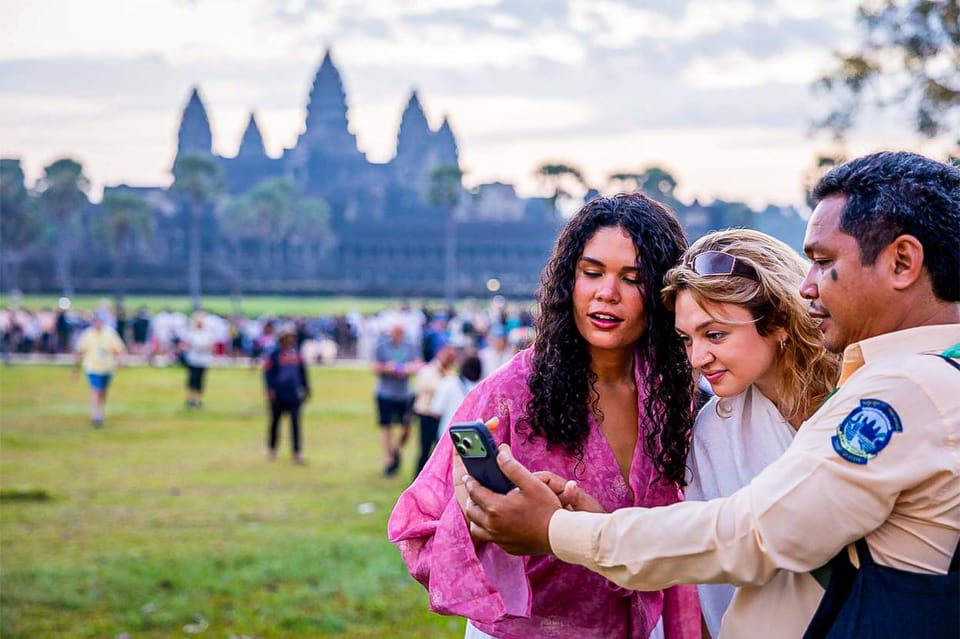
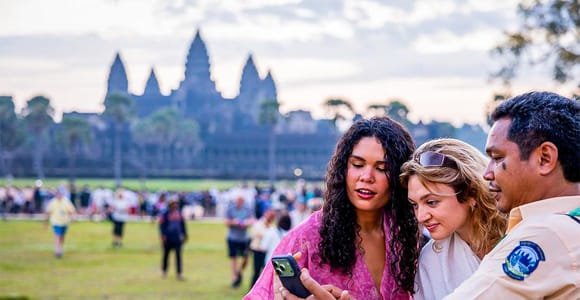
Almost everyone who comes to Siem Reap does the same thing on their first morning: they get up at half past four and drive six kilometres north in the dark. The question is not whether to go – it is who drives you and who explains what you are looking at.
The two realistic options cost roughly the same for one person and produce completely different mornings.
What actually happens between 04:45 and 07:00
The Angkor Archaeological Park opens at 05:00, and Angkor Wat itself is open from 05:00 to 18:00. Sunrise in Siem Reap falls between about 05:40 and 06:30 depending on the month; from September to November it is around 05:55 to 06:10. That means you are standing in the dark for a good forty minutes before anything happens.
You will not be standing there alone. On a normal peak-season morning, several thousand people gather at the northern reflecting pond – the one the postcard was taken from. The front-left corner of that pond gives the classic silhouette with the full temple mirrored underneath, which is exactly why it fills up first.
Two practical things nobody mentions:
Bring a torch. The western causeway is 350 metres of uneven sandstone, flanked by the seven-headed nāga balustrades, and it is genuinely dark. Phone torches work; phone torches held by three thousand people do not make the stones any flatter.
Buy the pass the evening before. The ticket office on Road 60 is open from 04:30 to 17:30, and a pass dated for tomorrow already lets you into the park from 16:45 this evening – and that evening does not count as one of your pass days. You can also buy online at the official Angkor Enterprise site. Either way, you do not want to be queuing at 04:45 on the one morning that has a deadline.
The small-group tour
The most-booked version of this morning is the small-group sunrise or sunset tour, which carries 12,198 reviews and starts at 13.18 €. Eight to nine hours, air-conditioned vehicle, English-speaking guide, hotel pickup, cold water and a cold towel.
One number matters more than the price: the Angkor pass is not included. The operator says so plainly – 37 US$ per person for a one-day pass, bought separately. So the honest cost of your first morning is the tour price plus 37 US$, not the tour price. Anyone comparing a 13 € tour against a 28 US$ tuk-tuk day is comparing the wrong two numbers.
The same operator notes the tour is not suitable for children under four or for people with back problems. That is their own restriction on their own vehicle and schedule, not a park rule – other offers draw the line elsewhere, so check the one you are booking.
What you get for the money is the part that has no price tag: somebody who can tell you that the five towers are not five towers but a quincunx, that the bas-reliefs on the southern gallery are a battle and the ones on the eastern gallery are a churning ocean, and which of the four faces of Bayon you are actually photographing an hour later.
Your own tuk-tuk
A tuk-tuk driver will collect you at 04:30 and wait. Published day rates in Siem Reap sit at roughly 20 to 30 US$ for a full temple day covering up to four passengers – individual operators list 28 US$ for a seven- to eight-hour day including cold water and towels, and drivers dealing directly often quote 15 to 20 US$ for the small or grand circuit with a surcharge of about 5 US$ for the pre-dawn start. For two or three people sharing, that is the cheapest way into the park by a wide margin.
A driver is not a guide. This is the single thing people get wrong, and it is worth being blunt about: your driver will get you to the right pond at the right minute, park in the shade, know exactly where to find you at Ta Prohm, and refill your water. He will not explain the bas-reliefs, because that is a different licensed profession and not what you paid for.
If you want both, hire a licensed guide separately and keep the tuk-tuk – that is a common combination and usually still cheaper than a private car. Look at the private tours if you would rather have it arranged as one booking.
The trap that catches people at 07:40
You can watch sunrise in whatever you slept in. You cannot climb the upper level in it.
The Bakan – the top tier of Angkor Wat – has its own rules and its own clock. It opens around 07:40, roughly two hours after you arrived, and closes around 17:00. Children under twelve are not allowed up. And it is closed on Buddhist holy days, which fall on about four days a month, set by the lunar calendar, so there is a real chance your particular morning is not one of the mornings it opens at all.
The dress code is enforced there and only there with any seriousness: shoulders and knees genuinely covered, a sleeved garment rather than a scarf draped over bare shoulders. Unlike temples in Thailand or Indonesia, Angkor does not lend out sarongs. People are turned away at the stairs every day.
So if the upper level matters to you, the sunrise morning is the wrong morning for it unless you are staying in the park until mid-morning anyway – which both options above do.
When sunrise is the wrong plan
Between roughly July and October the sky over Angkor is often simply grey at dawn, and September and October are the wettest months of the year with rain on most days. Getting up at 04:30 for a flat white sky is a genuinely bad trade, and no operator will tell you that when you book.
Two sensible alternatives in those months: go for sunset instead – the same flagship tour offers either – or keep the sunrise attempt for your second or third morning, once you have seen a real sky. With a three-day pass, a failed dawn costs you nothing but sleep.
Which one, honestly
Take the small-group tour if this is your only full day at Angkor, or if you want to understand what you are looking at rather than just photograph it. The pass is extra either way, so budget the tour price plus 37 US$ and stop comparing the headline figures.
Take the tuk-tuk if you have a three-day pass, are travelling as two or more, and are happy to read up in advance – or if you have already done a guided day and want a second, quieter dawn somewhere other than the north pond. Pre Rup and Phnom Bakheng both face the sun, and almost nobody is at either one at 05:30.
Either way, the pass goes in your pocket the night before. Everything else on this list is recoverable; that one is not.