Siem Reap with Children: Heat, Temples and What Kids Actually Like
Updated September 25, 2026 · 7 min read
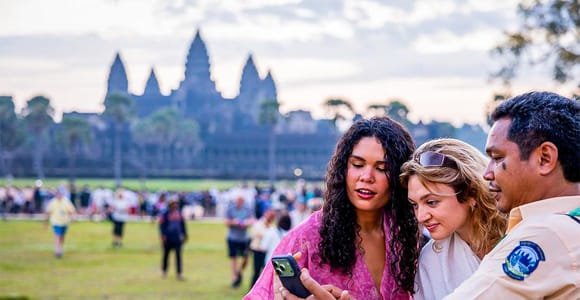
Siem Reap works better with children than its reputation suggests, but not in the shape most itineraries are written. Temples are hot, stone and abstract; the three things that reliably delight children here are a tree growing through a ruin, a wall covered in stone faces, and a boat. Build the days around those and it goes well.
The two rules that are actually rules
Children under twelve enter Angkor free. No ticket, no queue. But their age is not taken on trust – staff can ask for a passport, and without one you may find yourself buying a full 37 US$ pass for an eleven-year-old at the counter. The passports go in the day bag.
Children under twelve are not allowed up the Bakan, the top tier of Angkor Wat. That is a park rule and no ticket changes it. It matters for planning: if one parent wants to go up, the other is waiting at the bottom for twenty minutes, so decide in advance rather than at the stairs.
Everything else you will read about ages is an operator’s decision, not a rule, and they differ. The most-booked sunrise tour, for instance, states it is not suitable for children under four. A different offer will draw the line somewhere else. Check the listing you are booking rather than assuming a standard exists.
Heat is the thing that ends days early
This is the single biggest factor and the easiest to plan around.
From November to February it is roughly 25 to 30 °C and genuinely comfortable – this is the window to aim for with small children. In April it regularly sits at 35 to 38 °C and can reach 40 °C. From May to October it rains, with September and October the wettest months.
The workable rhythm in any month: out early, back by eleven, out again after four. Temples have almost no shade in the middle of the day, the stone radiates heat, and there is nowhere to buy a cold drink once you are inside a complex. A child who has been walking on hot sandstone since nine in the morning is finished by noon, and nothing after that will be enjoyable for anybody.
On sun and heat protection specifically: that conversation belongs with your pharmacy or your child’s doctor before you travel, not with a travel site. What we can say is the part that costs nothing – go early, take more water than you think you need, and plan the middle of the day as indoor time.
The tuk-tuk question, honestly
A private tuk-tuk is the vehicle most families end up preferring, and the reasons are good: it is open-sided so there is airflow, it has a roof for shade, you can stop whenever a child needs to stop, and the driver stays with your bags between temples. The most-reviewed private tuk-tuk temple tour carries 2,783 reviews at 17.28 € for the whole vehicle, up to three people, for around eight hours.
The part operators do not put in the description: tuk-tuks have no seatbelts and no child seats. They are open at the sides, the roads around the park carry coaches, and a toddler on a bench seat is held by whoever is holding them. That is not a reason to rule it out – it is how nearly everyone travels here – but it is a decision for parents to make knowingly rather than discover. Families who are not comfortable with it should book an air-conditioned car instead, which most operators offer on the same routes.
What children actually like here
Ta Prohm. The temple with the trees growing out of it. For a child this is not archaeology, it is a jungle that ate a building, and it lands immediately. Go early – it is one of the busiest temples on the inner circuit.
The faces at Bayon. Two hundred-odd stone faces at child height and above, and a genuinely good game: find the one that is smiling at you. Morning or late afternoon, when side light brings them out.
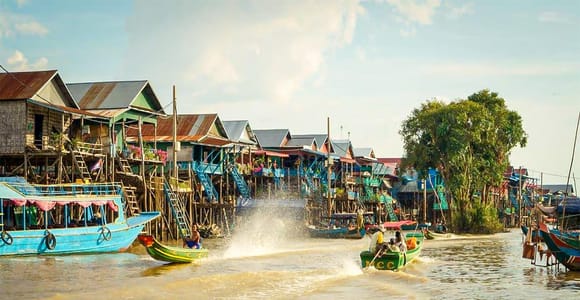
Boats. The floating villages on the Tonlé Sap are a boat ride through houses on stilts, with children paddling themselves about in metal tubs. Two honest cautions: the boats are open with low sides and no railings worth the name, and there is no shade on the water. For confident swimmers upwards it is a highlight. With a toddler it is a long time to hold on to somebody.
The circus. Phare, the Cambodian Circus has 2,239 reviews at 15.82 € and is the single easiest evening with children in Siem Reap – acrobatics and live music, no language barrier, about an hour, and it starts early enough that nobody falls asleep in it. The Apsara dance dinner shows are beautiful and slow; older children manage them, small ones generally do not.
Making something. A pottery class gives them a wheel and clay, and the family cooking classes – the most-reviewed one carries 1,382 reviews at 25.48 € for about three hours – involve a market visit and knives, so they suit school age upwards rather than toddlers.
Pushchair or carrier – carrier
There is very little level, paved ground at Angkor. Temple floors are uneven sandstone with raised thresholds, the stairs are steep and mostly without handrails, and the paths between structures are sand and tree roots. A pushchair will spend the day being carried. A back or hip carrier is the right tool, with a sun hat on the child, and it doubles as the thing they fall asleep in on the way back.
Two local cautions
The macaques. There are monkeys along the park roads and in the flooded forest at the lake. They are wild, they associate people with food, and they will take it from a child’s hand. Do not let children feed them and do not let a child carry an open snack. If one approaches, the adult takes the food, not the child.
The stairs at sunset spots. Phnom Bakheng is a climb, and the hill is busy and unlit on the way down. If you are doing a sunset with small children, Pre Rup or a boat is the easier version of the same hour.
A two-day shape that works
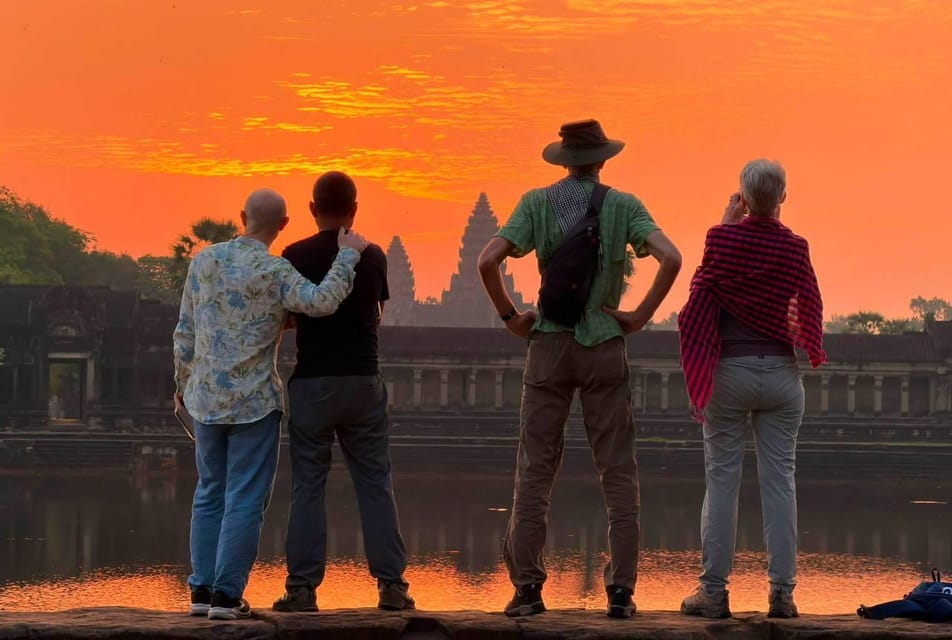
Day one: sunrise or an early start at Angkor Wat, then Ta Prohm, then Bayon, back to the pool by eleven. Circus in the evening.
Day two: the lake in the morning, an afternoon off, and a pottery or cooking class late in the day.
Two temple mornings is about the ceiling for most children, and the pass arithmetic works out the same either way, because the children are not paying for one.