Street Food by Tuk-Tuk in Siem Reap: What You Try, and What to Watch For
Updated September 25, 2026 · 6 min read
Siem Reap’s food is better than its reputation, and the reason people miss it is geography. The visitor version happens on and around Pub Street, where the menus are in four languages and the cooking is aimed at people who arrived yesterday. The version locals eat happens a few streets out, and you will not find it by wandering.
That is the whole case for a guided food tour here. Not the food – the addresses.
What the evening on a tour looks like
The most-reviewed one – 376 reviews, from 30.75 €, three to four hours in the evening – runs roughly like this, and the itinerary is worth reading because it tells you exactly what “ten tastings” means:
- Lort cha at a family house: short, fat rice-pin noodles fried hard on a flat pan with beef and egg. About 90 minutes of the tour is street food tasting.
- The Made in Cambodia Market, half an hour – crafts and silk rather than food, and the one stop on the list that is shopping.
- Num banh chok, 45 minutes. Rice noodles under a green fish-based curry, eaten for breakfast here. If you try one Cambodian dish, try this one.
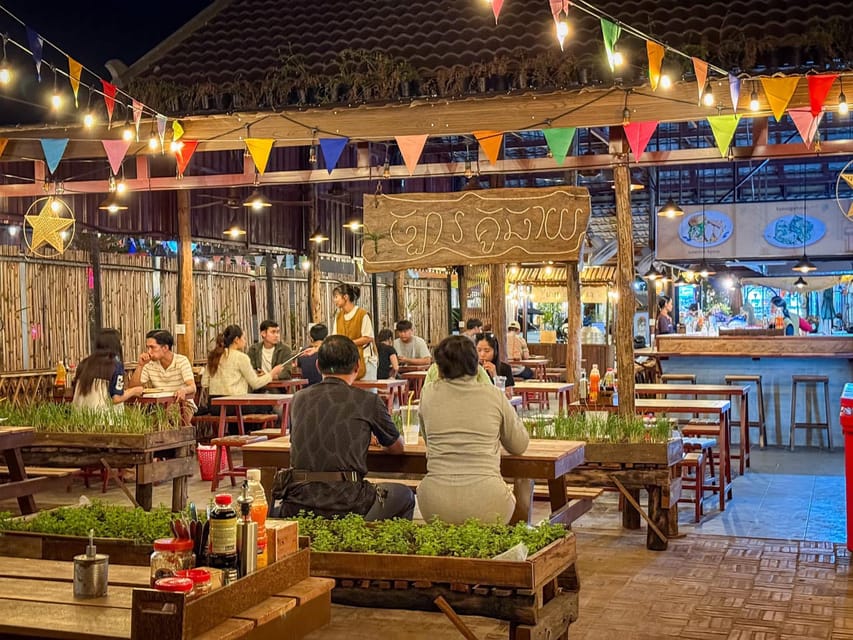
- Street 60, half an hour. This is the stop that justifies the ticket: an ordinary local eating street with grilled skewers, fried chive cakes, snails, frog, crispy pork.
- The Asana Old Wooden House cocktail bar, in a 1960s Khmer timber house – the only one of its kind left in the centre.
One can of local beer and bottled water are in the price. Wine and anything you order for yourself are not.
There is a four-hour evening version with ten tastings from 30.75 € as well, 250 reviews, and shorter small-group variants further down the food tour listings – 87 offers in total, from 10.54 €, median around 35 €.
The insects, plainly
Every tour here builds up to them, and the marketing is relentless, so here is the unromantic version.
You will be offered crickets, red ants, grasshoppers, water beetles and tarantula, deep-fried, usually with salt, lime leaf and sometimes chilli. Crickets taste of the oil and the seasoning and have the texture of a prawn shell. Tarantula is the one people photograph; the legs are crisp and the abdomen is not, and it is the one most people try once.
On your own at a night market stall they cost roughly 0.50 to 1 US$ apiece. Nobody is taking a tour for the insects – you are taking it for the guide who can tell you which stall fries them fresh rather than reheats them. Also worth knowing: this is real food here, not a dare. Red ants in particular are a normal ingredient in a stir-fry, sour like a squeeze of lemon. Treating it as a stunt in front of the person cooking is bad manners.
If insects are a hard no, say so at booking. Every operator on this list will simply substitute, and none of them will mind.
Doing it without a tour
Entirely possible, and cheaper. Three rules make the difference:
Eat where there is a queue of people who live here. The stall with turnover is the stall with fresh oil. This is the whole of food hygiene in one sentence.
Eat it hot and cooked in front of you. Grilled skewers, fried noodles, soup ladled from a pot that is bubbling. The things worth more caution are the ones that sat out: pre-cut fruit, room-temperature coconut milk desserts, ice of unknown origin in a drink from a cart. If your stomach is the thing you are worried about, that is a question for a pharmacy or a doctor before you travel, not for a blog.
Go where the tour goes. Street 60 in the evening, the night markets, the num banh chok stalls in the morning. You can walk into every one of those without a guide.
What you lose doing it alone is the explanation – what is in the green curry, why breakfast is a noodle soup, what prahok is and why it smells like that. That is worth 30 € to some people and nothing to others, and both answers are reasonable.
When to go, and who it does not suit
Evening, obviously – the night markets and Street 60 only exist after dark, and the heat has dropped. A tour that starts around five gets you sunset on the way and the markets at full tilt.
Come hungry. Ten tastings across an evening is dinner. Reviewers say so repeatedly, and they are right: do not book a table for afterwards.
It is a tuk-tuk, with open sides. That is pleasant at eight in the evening and dusty on the way out of the centre. In the rainy season it also means a downpour is part of the experience, since these tours run in most weather.
Not the obvious choice with small children. Late finish, standing up, spicy and unfamiliar food. The culture and village experiences or a daytime market visit work better at that age – see Siem Reap with children.
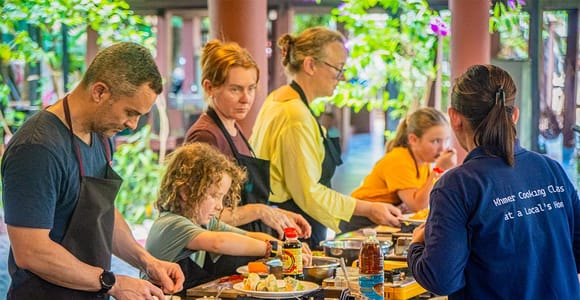
If you would rather make the food than eat your way through it, the Khmer cooking class covers the same ingredients from the other end: four dishes instead of ten tastings, and the market in daylight.
One honest reservation
A food tour is the easiest activity in Siem Reap to overpay for. An evening and ten small plates is a good evening out; it is not a rare or difficult thing to arrange, and at 30 € it costs more than the whole of the two-hour city walking tour at 5.27 €, which covers the Old Market and the river and leaves you free to eat wherever you like afterwards.
So: book the food tour if you want somebody to take you to Street 60 and explain it. Skip it if you are happy to eat by pointing, which in this town works better than almost anywhere. Either way, do not spend the evening on Pub Street and conclude that you have eaten Cambodian food.