Banteay Srei: The Pink Temple, and Why It Is Never Sold on Its Own
Updated September 25, 2026 · 6 min read
Banteay Srei is the temple people come back talking about, and it is also the smallest thing on their itinerary. Both of those facts are true at once, and together they explain why you will never find it offered alone.
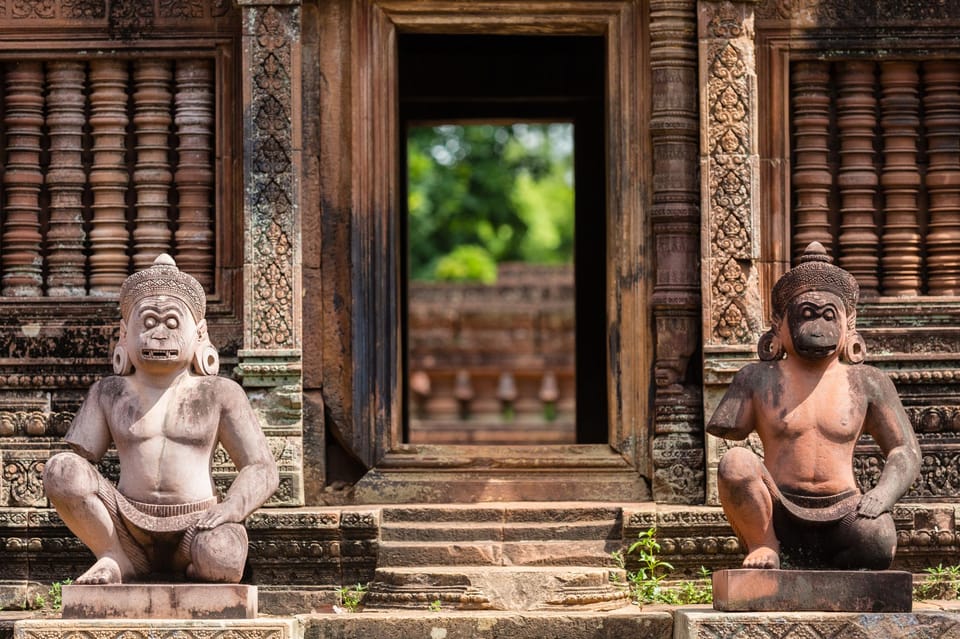
It stands about 32 km north-east of town, an hour by road – the booking itineraries allow an hour each way and they are not padding. It was consecrated on 22 April 967, dedicated to Shiva, and unlike almost everything else in the park it was not built by a king: its founding stela names two courtier brothers, Yajnavaraha and Vishnukumara, counsellors to Rajendravarman II. That shows. The scale is domestic. Doorways come up to your shoulder, the towers are the height of a room, and the whole enclosure would fit inside one courtyard of Angkor Wat.
Why it is worth the drive
The stone. Banteay Srei is built largely from a reddish-pink sandstone that is harder and denser than the grey stone used at Angkor Wat and Bayon – and that is precisely why the carving here goes further. It takes an edge almost like wood, and then it keeps that edge. A thousand years of monsoons later, it is still holding it.
The result is the most complete carving anywhere at Angkor. Not the biggest – the most complete. Virtually every available surface is worked: foliage that runs like embroidery over whole walls, guardian figures in niches, and pediments telling scenes from the Ramayana and the Mahabharata in a depth that is closer to sculpture than relief. The inner enclosure – the sanctuary and the two libraries flanking it – is where the finest of it sits, and it is a small space, which is part of the problem below.
Its usual nickname, the Citadel of the Women, comes from the delicacy of the carving rather than from any record of who made it. Guides will tell you the work was done by women; there is no evidence either way, and the honest version is that nobody knows.
The stone also decides your timing. Pink sandstone at noon under a white sky is grey-brown and flat. Early morning or late afternoon is when it turns the colour you booked it for, and the same low light is what brings the carving out of the wall. Midday is the worst hour here. The most-booked offer avoids it – it collects you before eight and reaches the temple about an hour later – but any itinerary that puts Banteay Srei after two or three other temples arrives in exactly the wrong light.
The part nobody tells you: it is small
Forty-five minutes to an hour and a quarter and you have seen it properly. The most-booked offer allows 80 minutes, which is generous and about right if it is busy.
And it will be busy. A small enclosure, a single narrow route through the inner courtyard, and coach groups arriving in blocks – Banteay Srei is the most congested small temple in the region. The inner sanctuary in particular is a queue rather than a room at the wrong hour. If you have any say over the start time, take the earliest one offered.
This is also the honest answer to “is it worth an hour’s drive each way for an hour of temple?” On its own: no. Combined with anything else on that road: easily.
The combinations, and which to pick
Everything north-east of town shares the same road, which is why Banteay Srei always travels with company. The temple offers – 223 of them, from 7.91 €, median around 48 € – arrange it three ways.
With the Grand Circuit. The most-booked version, 392 reviews, 9 hours from 17.57 €, limited to 10 people: Banteay Srei plus Pre Rup, Ta Som, Neak Pean and Preah Khan. This is the best value on this page by a wide margin, and it is the right choice if you have already done Angkor Wat and Bayon and want the outer ring. One caveat worth reading the itinerary for: offers advertising “five temples” do not agree on which five – this one’s written description mentions East Mebon while its stop list does not. Check the stops, not the number.
With Kulen. Banteay Srei, the Kulen waterfall and Beng Mealea, 10 hours from 40.33 €, 246 reviews. A long day and a lot of driving, but it puts the three big outliers into one trip. Note that Phnom Kulen carries its own 20 US$ ticket on top of your pass, and the mountain road closes upward at 11:00 – that cutoff, not the distance, is what shapes the day.
With Kbal Spean. The carved riverbed about 13 km further up the same road, and the one the guidebooks confuse with Kulen’s lingas. It is covered by your pass, it involves a walk uphill of roughly 1,500 m through forest, and it is the pairing to choose if carvings rather than scale are what you came for. The difference between the two linga sites is the single most useful thing to get straight before you book either.
Two smaller stops sit on the same stretch and are easy to add: Preah Dak village, on the road past Pre Rup, where the roadside stalls sell palm sugar and the sweets made from it, and the Cambodia Landmine Museum, about 25 km out and a short way from Banteay Srei. The museum is not a temple detour – it is a genuinely sobering half-hour founded by a former child soldier who went on to clear mines – and it changes the tone of the day. Worth knowing in advance rather than discovering it between two temples.
Practical, briefly
Your Angkor pass covers it. There is no separate Banteay Srei ticket, and the pass is checked at the temple. Note that the most-booked Grand Circuit offer lists the pass itself outside the price, along with lunch – a common arrangement, and the reason a 9-hour day can be advertised from 17.57 €. Budget the pass separately.
Gates are 07:30 to 17:30, so the early slot and the late slot both exist. The late one has the better light and the thinner crowds; the early one has the cooler air.
Dress as for any temple: shoulders and knees covered, no shorts and no sleeveless tops. Operators put it plainly – entry may be refused if you turn up without – and Banteay Srei is an active religious monument, so the expectation is the same as at the main temples.
The ground is uneven and several doorways have a high sill to step over. Operators on this route commonly list their trips as unsuitable for people with mobility impairments, and the most-booked offer lists its shared option as unsuitable for children under 12 – ask the operator about your specific needs rather than assuming, and get the answer before you pay.
If temples are what brought you here, this one is the argument against doing Angkor in a single day: it is an hour out of town and it is the finest carving in the country. Our two-day plan offers it as the first choice for day two, for exactly that reason.