Phnom Kulen: The Waterfall, the Lingas, and Whether the Day Is Worth It
Updated September 25, 2026 · 6 min read
Phnom Kulen is the mountain everyone in Siem Reap will offer you once you have done the temples. It is about 48 km from town, roughly an hour and a half to two hours’ drive each way, and it is the one day trip where the practical details genuinely decide whether you have a good day or a frustrating one.
Three things to settle before you book
It is not on your Angkor pass. Phnom Kulen National Park sits under a different authority with its own ticketing, and entry is 20 US$ per person on top of whatever you have already paid for Angkor. This catches people out constantly. Some offers include it – one is literally titled “Kulen Waterfall Guide + Entrance Fee + Lunch” – and many do not. Check the inclusions rather than assuming.
The road only goes one way, and it goes up in the morning. The mountain road is single-track, so traffic is managed in one direction at a time: up in the morning, down later. You need to be through the gate before 11:00, and that cutoff is enforced. Miss it and you do not get up at all that day. If you are arranging your own car or tuk-tuk, work backwards: with a ninety-minute drive, leaving town after nine is cutting it fine.
It is a full day, not a half. Two hours of driving, the mountain, the waterfall, lunch, two hours back. The Kulen offers run from 16.70 € with a median around 66 € across 49 offers, and the durations tell you the truth: the most-reviewed small-group version is eight hours with 2,212 reviews at 42.18 €, the waterfall-and-lingas version is nine hours with 1,050 reviews, and there is a ten-hour combination that adds Beng Mealea and the Tonlé Sap. Ten hours with a driver is a long day in any climate and a very long one at 38 °C.
The thousand lingas – read this before you get excited
This is the single most useful thing on this page, because two different places share almost the same name and the guidebooks blur them.
Kbal Spean is the famous one. A riverbed with carvings stretching roughly 150 m – lingas and yonis in a grid the water runs over in a thin sheet, plus carved scenes from Hindu mythology on the bed and banks. It is genuinely remarkable, and it is covered by your Angkor pass, on the road towards Banteay Srei.
The thousand lingas on Phnom Kulen are a different site: an open area with a small stream running over linga carvings that are, honestly, indistinct, and without the surrounding mythological carvings. It has real religious significance and very little visual drama.
So if carvings in a riverbed are the reason you were going to Kulen, go to Kbal Spean instead. You will see more, pay nothing extra, and be back in town for lunch. Kulen is worth the day for other reasons.
What is actually good up there
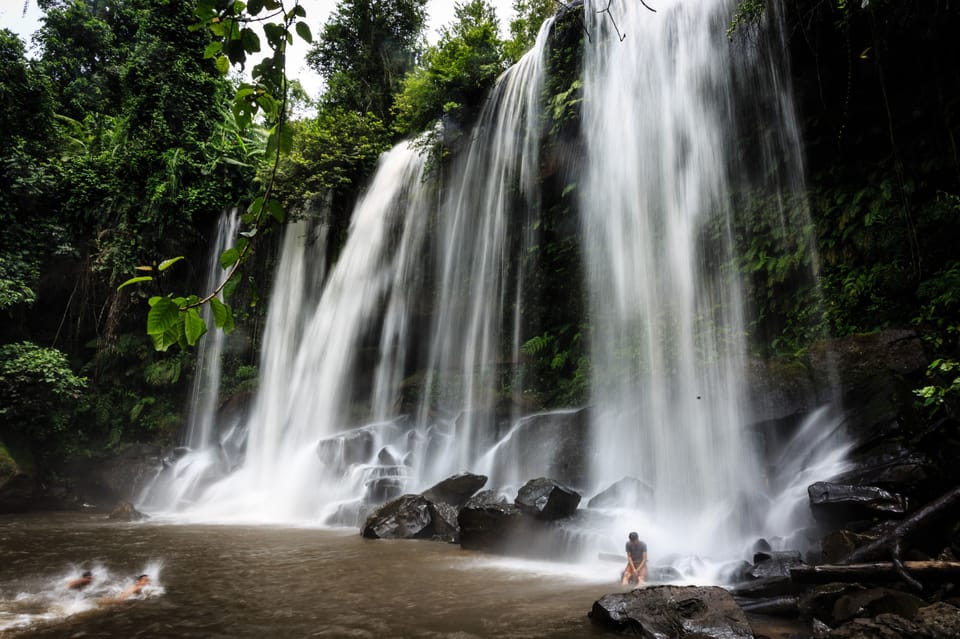
The waterfall. Two levels. The upper one is shallow and flat, which makes it the practical choice with younger children; the lower fall is the main event and the one people swim under. It is at its most powerful in and just after the rainy season, roughly May to October – which is also when the drive is wettest. In March and April the flow is much weaker, and that is exactly when the heat makes you most want it. There is no month that gives you both.
The reclining Buddha at Preah Ang Thom, reported as the largest in Cambodia, cut from the rock at the top of the mountain.
The history. Kulen is where the Khmer empire is considered to have begun, which is what tour descriptions mean when they call it “the birthplace of the Angkor Empire”. Standing on the mountain that the whole Angkor project started from, with the plain below, is a different feeling from standing in another gallery.
Two things to know about behaviour: this is an active pilgrimage site, not a swimming hole with a temple attached. Cambodians come here to make offerings. Dress and conduct yourself as you would in any temple, and that includes at the waterfall.
Is it worth it? An honest answer
Yes, if you have four days or more in Siem Reap, you want a day that is trees and water rather than sandstone, and you are travelling between roughly June and November when the fall is full. It is also the best answer to temple fatigue, which arrives sooner than most people plan for.
No, if you only have two or three days. On a short trip the mountain costs you a whole day and 20 US$ to see something that is good but not better than what you would do instead with the same hours – the outer temples and Banteay Srei, or a second, quieter morning inside the park. Our two-day plan deliberately leaves Kulen out for this reason.
Probably not, if you are going mainly for the lingas. See above.
The practical list
Small notes for the entrance and for food; nothing up there takes cards. Something you can swim in and something dry to change into, plus a towel, because there is nowhere to buy either. Shoes with grip – the rock around the lower fall is wet and polished. And a plan that has you through the gate before 11:00, which is the one item on this list that cannot be fixed later in the day.
The 20 US$ is separate from everything else, including your Angkor pass – budget it as its own line rather than discovering it at a barrier 48 km from your hotel.